Hormone Tests for Perimenopause: Do You Need One, and When to Test
Why one blood test usually can't confirm perimenopause, and if your doctor orders labs, which cycle day to test FSH, estradiol and progesterone.
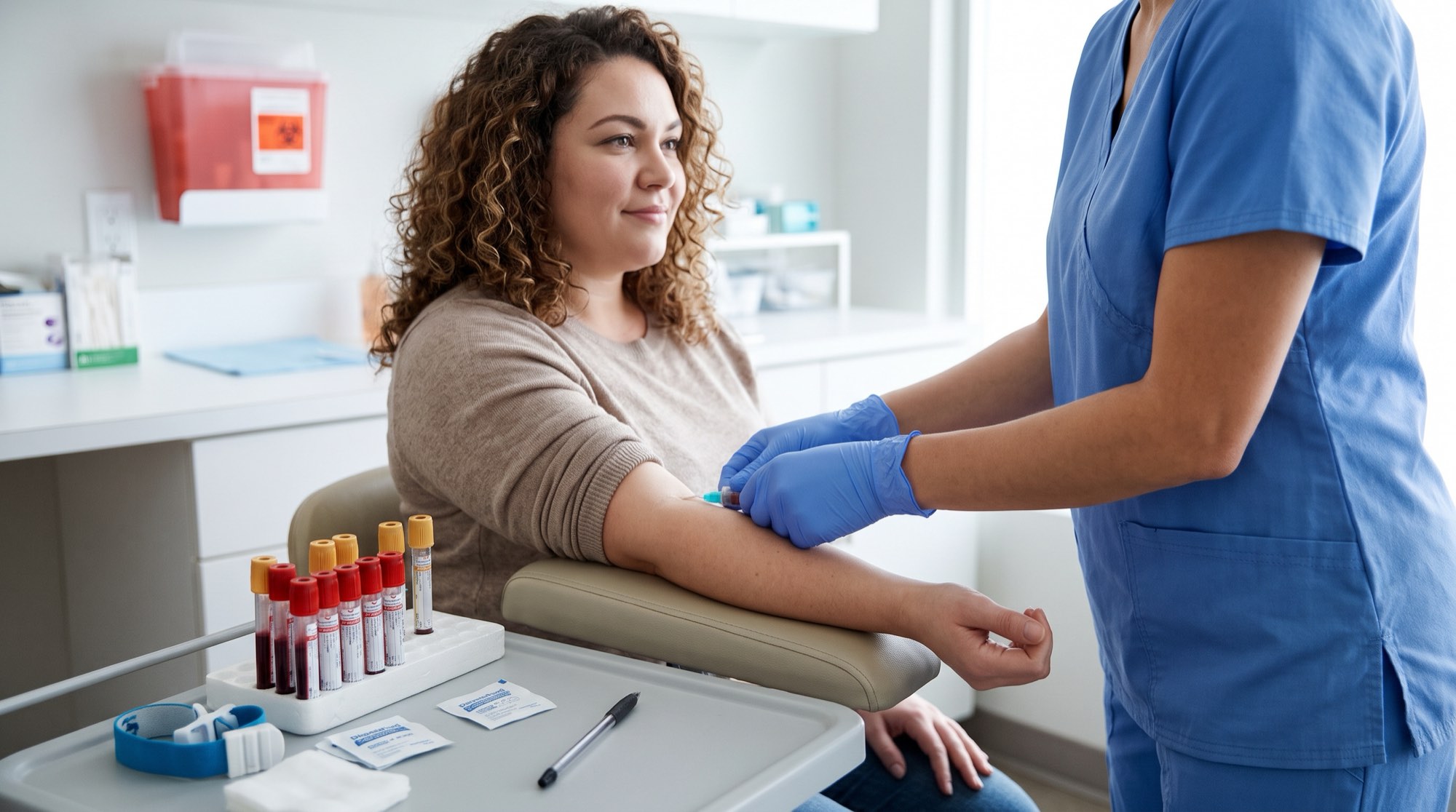
There's no single test for perimenopause. Hormone levels swing so much from day to day that one blood test can look normal on a day you feel awful, which is why most doctors diagnose it from your age, symptoms and cycle changes over time. But labs still get ordered: to rule out other causes, if you're under 45, or because you've bought an at-home kit. If you are being tested, the best time is cycle day 2 to 5 for FSH and estradiol, and about 7 days before your next expected period for progesterone. That's day 21 only if your cycle runs 28 days.
Key takeaways
- One blood test usually can't confirm perimenopause, because hormones swing from day to day. After 45, it's usually diagnosed from symptoms and cycle changes, without blood tests.
- Testing matters most before 45, to rule out other causes, or when something doesn't add up.
- If you're tested, check FSH and estradiol on cycle day 2 to 5, and progesterone about 7 days before your expected period.
- If your cycle isn't 28 days, count back 7 days from your expected period instead of defaulting to day 21.
- A pattern across tests and cycles matters more than any single blood draw.
- Rule out pregnancy and thyroid problems before putting irregular periods or symptoms down to perimenopause.
- Bring dated labs and a 60 to 90 day symptom log to your appointment, so your doctor can see the pattern.
Do you need a hormone test for perimenopause at all?
Often, no. Perimenopause is defined by what's happening to your cycle and your symptoms, not by one lab number. In women over 45 with symptoms like hot flashes and irregular periods, the UK's NICE guideline recommends diagnosing perimenopause without blood tests. NICE's reason is the point of this whole article: FSH "fluctuates considerably over short periods of time" in the years before menopause, so a blood level adds little to what your symptoms already show.
Testing earns its place in other situations:
- You're under 45 and your cycles or symptoms are changing. Between 40 and 45, NICE suggests considering an FSH test. Under 40, testing helps check for early menopause (premature ovarian insufficiency).
- Your symptoms don't fit neatly, and your doctor wants to rule out other causes.
- You want a baseline to compare against later, or a clinician has asked for one.
If you are testing, timing decides whether the result means anything.
Why does cycle timing matter more in perimenopause?
Before perimenopause, most cycles follow a predictable script. Estrogen rises before ovulation, progesterone rises after it, and a blood test on a known cycle day gives a fairly consistent answer.
Perimenopause breaks that script. More cycles are anovulatory, meaning no egg is released and no progesterone rise follows. The ovaries also respond unevenly to the brain's signals, so FSH and estradiol can swing from one extreme to the other within days. Your hormones on day 12 of this cycle may look nothing like day 12 of next month's.
What swinging hormones do to test results
A level that reads "normal" can sit next to a level that reads "perimenopausal" two weeks later, and both can be accurate snapshots of an unstable system. That's why clinicians lean on patterns over single numbers, and why your own notes on symptoms and cycle length matter as much as the lab slip.
Test FSH on a day when your ovaries happen to be working hard, and you'll look fine. Test it again a few weeks later and it may be high. One draw catches whatever your cycle is doing that day. Repeat draws catch the pattern.
Which hormones should a perimenopause blood test include?
A useful panel covers the hormones that shift in perimenopause, plus the conditions that can mimic it. The STRAW+10 staging system, which researchers use to describe the stages of reproductive aging, puts cycle changes first. Hormone levels like FSH are supporting evidence, not the definition.
FSH and estradiol: the core pair
FSH (follicle-stimulating hormone) rises as the ovaries become less responsive. Estradiol, the main form of estrogen, swings up and down before it falls. Read them together: a high estradiol can push FSH down that day, so an FSH result means more when you know the estradiol beside it.
Progesterone: a check for ovulation
Progesterone rises only after you ovulate. A low level in the second half of your cycle suggests you didn't ovulate that cycle. Cycles without ovulation are common in perimenopause and can bring heavier, less predictable bleeding.
What else your doctor may check
- TSH, a thyroid test. An underactive or overactive thyroid can cause fatigue, weight changes, mood shifts and period changes that look a lot like perimenopause.
- A pregnancy test, if you could be pregnant. Skipped periods in your 40s can still mean pregnancy.
- Prolactin, sometimes, if your periods have become irregular or stopped.
- AMH (anti-Müllerian hormone) gives a rough picture of your remaining egg supply, but it can't tell you when menopause will happen, and NICE advises against using it to diagnose perimenopause in women over 45.
- Testosterone doesn't diagnose perimenopause. It's worth asking about only if low libido is a main concern.
On which cycle days should you test FSH, estradiol and progesterone?
Two blood draws beat one. FSH and estradiol belong at the start of your cycle, progesterone near the end. Testing all three on the same day tells you little, because each hormone only means something at its own point in the cycle.
| Hormone | When to test | What it tells you |
|---|---|---|
| FSH | Cycle day 2 to 5 | Whether your brain is working harder to get your ovaries to respond |
| Estradiol | Cycle day 2 to 5 | Your baseline estrogen, before it climbs toward ovulation |
| Progesterone | About 7 days before your expected period (day 21 of a 28-day cycle) | Whether you ovulated that cycle |
Day 2 to 5: your baseline
Day 1 is the first day of real bleeding, not spotting. Count from there. On day 2 to 5, FSH and estradiol are both near their lowest, which makes this the cleanest baseline you'll get. A high FSH here suggests your brain is compensating for quieter ovaries.
About 7 days before your period: the ovulation check
Progesterone peaks about a week after ovulation. On a 28-day cycle that's day 21. On a 31-day cycle, test around day 24. On a 35-day cycle, around day 28. A low result means either you didn't ovulate or you tested on the wrong day, which is why the draw date matters as much as the number.
When your cycle length keeps changing
Estimate your next period from your recent cycles, then test progesterone about 7 days before it. If you're not sure, NICE's fertility guidance suggests testing later in the cycle and repeating weekly until your period starts. Write the draw date and your cycle day next to every result.
What do hormone levels look like at different stages of perimenopause?
Early perimenopause: normal-looking numbers, real symptoms
Early on, FSH and estradiol often sit inside the standard reference range, even while your cycles start to vary by a week or more and sleep, mood or hot flashes change. Your hormones aren't "fine". A single blood draw just catches one day of a pattern that's starting to swing. Early perimenopause is defined by variability, not by any one number.
Late perimenopause: when FSH starts climbing
Once you're going 60 days or more between periods, you're likely in late perimenopause. Ovulation is less frequent, the brain releases more FSH to compensate, and estradiol swings higher and lower between cycles. FSH is more likely to read high now, though it can still bounce back into range a month later. Two tests in different cycles tell a more honest story than one.
Why "normal" ranges don't always fit
Reference ranges are usually split by cycle phase, and a result only means something against the day it was drawn. As MedlinePlus puts it, results depend on where you were in your cycle when the sample was taken. A result flagged "normal" can still be the wrong number for your cycle day. Bring the date of your last period with your lab slip so your doctor can read the number in context.
When is the worst time to test hormones for perimenopause?
The worst results are the misleading ones: a test taken at the wrong point in your cycle can look reassuring while your symptoms say otherwise.
Mid-cycle: the FSH trap
FSH rises naturally just before ovulation. A mid-cycle blood draw can read "high" in someone whose ovaries are working normally, or read normal on a day when it would be high a week later. In perimenopause, cycles without ovulation make FSH and estradiol even less predictable, which is more reason to stick to day 2 to 5.
Day 21 when your cycle isn't 28 days
Day-21 progesterone only checks for ovulation if you ovulated around day 14. On a 35-day cycle, day 21 may be before ovulation, so a "low" result only tells you that you tested too early. Count back 7 days from your expected period instead.
While you're on hormonal birth control
The combined pill, patch and ring, and high-dose progestogen, change your FSH, so NICE advises against using FSH to diagnose perimenopause while you're taking them. Talk to your doctor before stopping any birth control.
When should irregular or missed periods change how you test?
Once your cycle length varies by more than a week from one cycle to the next, or you're skipping periods, cycle-day timing stops meaning much. You can't anchor tests to day 3 or day 21 when you don't know where you are in the cycle. Symptom and cycle tracking becomes your main evidence.
Before putting anything down to perimenopause, rule out pregnancy and thyroid problems. Both can cause skipped periods and symptoms like fatigue and brain fog, and both are simple tests your doctor can order.
With timing off the table, repeating the test matters more than perfect timing. A pattern across several draws tells your doctor more than any one result.
How often should you retest hormone levels in perimenopause?
If you're testing, repeat the same panel at the same point in your cycle about 4 to 8 weeks later. When early menopause is a question before 40, NICE recommends two FSH tests 4 to 6 weeks apart for exactly this reason: one result isn't enough.
Think of each draw as one frame of a video, not a verdict. Comparing a day-21 draw to a day-3 draw tells you nothing, so match the cycle day. Between tests, track your symptoms: night sweats, brain fog, sleep and cycle length. The trend across two or three matched draws, paired with your symptom log, is what makes the pattern visible, and it gives your doctor something concrete to act on instead of "come back and try again later."
How do you turn test results into an appointment your doctor takes seriously?
What to bring: dated labs and a symptom log
A lab slip with no context is easy to wave off. A panel labeled with the cycle day it was drawn, plus a 60 to 90 day log of hot flashes, night sweats, brain fog, sleep and period dates, is much harder to dismiss. Keep the symptom summary to one page so your doctor can scan it in under a minute. If a result was drawn on the wrong cycle day for that hormone, say so yourself, and ask whether a repeat on the right day would change anything.
Where Kyha helps, and where it doesn't
Because one test can't confirm perimenopause, your record of symptoms and cycle changes is the evidence that counts. That record is what we built Kyha for. Tell it how you're feeling and it logs it for you, alongside your cycle, then shows the patterns over time. Answer a few questions and it shows which stage of the transition your answers match, then turns everything into a plan and a health report you can bring to your appointment.
What Kyha doesn't do: order labs, interpret your results, diagnose or prescribe. You still need a clinician for the blood draw and any treatment decision. Kyha gives you the record a clinician can actually work with.
Frequently asked questions
Can a hormone blood test be normal and still be perimenopause?
Yes. In early perimenopause, FSH and estradiol often sit inside the standard reference range even while your cycles change and symptoms appear. Hormones swing from day to day, so one draw catches a single snapshot of an unstable system. A normal result alongside steady symptoms and cycle changes is a reason to keep tracking and talk to your doctor, not a reason to stop looking.
Is day 21 the right day for progesterone if my cycle is longer than 28 days?
No. Day 21 only works if you ovulated around day 14. On a 35-day cycle, day 21 may be before ovulation, and a low result just means you tested too early. Count back 7 days from your expected period instead, so a 35-day cycle means testing around day 28. Write the draw date down with the result.
Are at-home hormone test kits accurate for perimenopause?
They have the same limits as a clinic test, and some have more. Urine FSH kits can only show whether FSH is higher than normal on the day you test, and FSH swings from day to day in perimenopause, so a negative result doesn't rule it out. Whatever the source, the same timing rules apply, and one result is a snapshot, not a diagnosis.
Do I need to stop birth control before testing my hormones?
Don't stop on your own. The combined pill, patch and ring, and high-dose progestogen, change FSH, so results drawn while you're taking them are hard to read. Many clinicians rely on your symptoms and cycle history instead, and test only if you decide to come off birth control. Ask your doctor what makes sense for you.
What's the difference between a perimenopause test and a menopause test?
There's no separate panel: both look at the same hormones. The difference is how they're read. Perimenopause is defined by symptoms and cycle changes, with results that swing, so timing and repeat testing matter. Menopause is confirmed after 12 months in a row without a period, and is usually diagnosed from that alone.
Sources
- Menopause: identification and management (NG23), NICE
- Menopause (NG23): implementation, getting started, NICE
- Executive summary of the Stages of Reproductive Aging Workshop + 10 (STRAW+10), Menopause (2012)
- Fertility problems: assessment and treatment (CG156), NICE
- Follicle-stimulating hormone (FSH) levels test, MedlinePlus, US National Library of Medicine
- Progesterone test, MedlinePlus, US National Library of Medicine
This article is for education, not medical advice. Talk to your doctor about your symptoms and before changing any treatment.