Night Sweats in Perimenopause: Causes and Relief
Why perimenopause causes night sweats, what they feel like, how long they last, and the fixes and treatments that actually help.
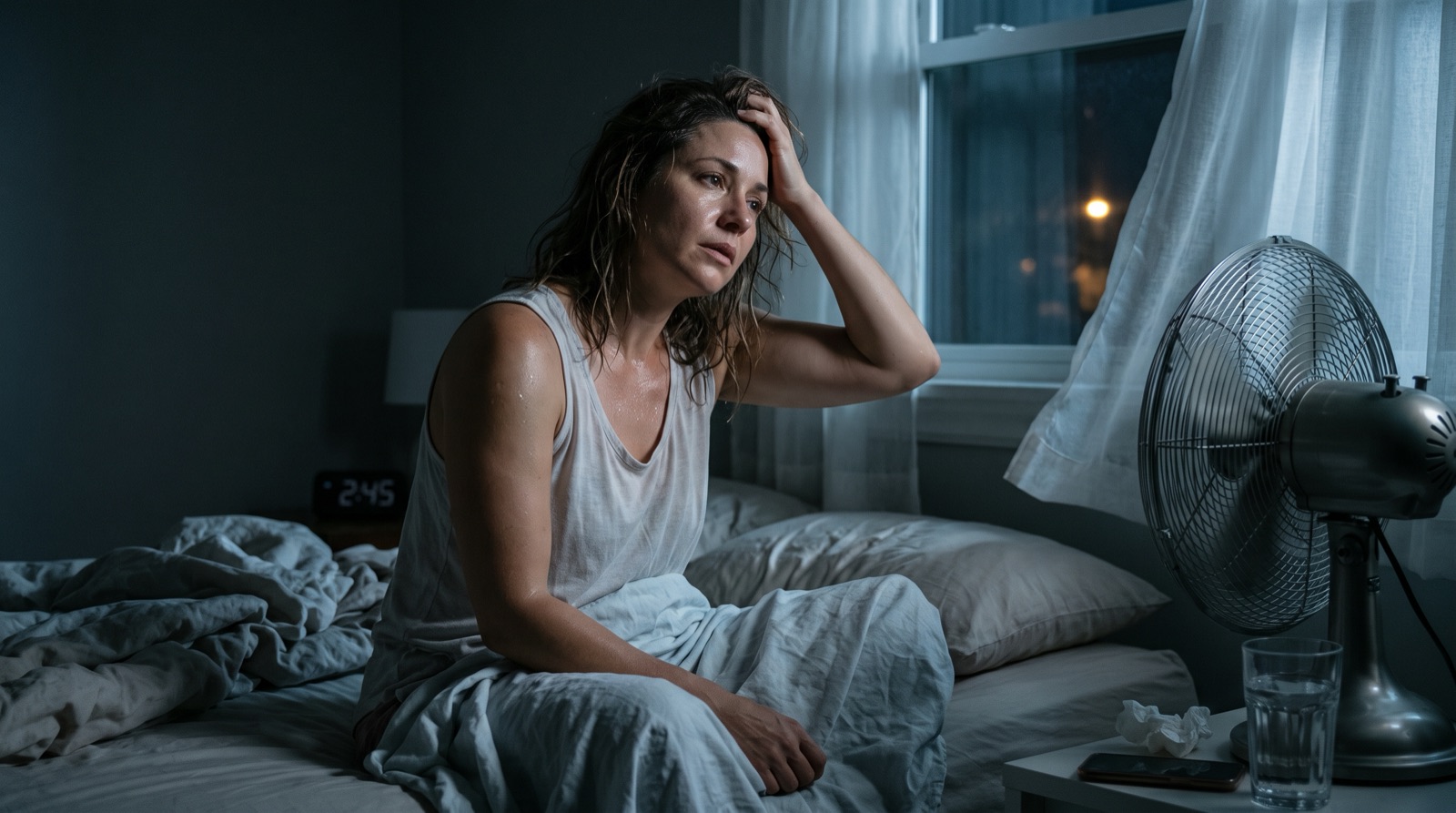
Here's what night sweats feel like, when they show up, and how to cool them down tonight.
Key takeaways
- Night sweats in perimenopause are caused by fluctuating estrogen disrupting the hypothalamus's temperature regulation, not by a smooth hormonal decline.
- Normal FSH or estradiol blood tests do not rule out perimenopause, since a single reading snapshots one day of a moving target.
- Vasomotor symptoms last a median of about 7 years, with earlier starters experiencing the longest duration, per the SWAN study.
- Cooling the bedroom to 65–68°F, layering bedding, and logging triggers like alcohol and evening caffeine are the fastest practical fixes.
- A 60–90 day dated symptom log turns vague complaints into evidence a dismissive provider cannot wave away.
What causes night sweats in perimenopause?
The estrogen-fluctuation mechanism, briefly
Night sweats in perimenopause are vasomotor symptoms, the same family as hot flashes. As your ovaries wind down, estrogen doesn't decline smoothly. It swings, sometimes higher than usual, sometimes sharply lower, and your hypothalamus overreacts to those swings by widening blood vessels and dumping heat. The Menopause Society (formerly the North American Menopause Society) describes this thermoregulatory disruption in its position statement on vasomotor symptoms. Because the swings are erratic, the sweating is too: some nights fine, others soaked.
Why 'normal labs' don't rule it out
A single blood test snapshots one day of a moving target. You can have textbook symptoms with a normal FSH or estradiol reading, which is why many clinicians diagnose perimenopause clinically, from your symptom pattern and cycle changes, not from labs.
Non-hormonal causes worth ruling out
Thyroid overactivity, certain antidepressants and blood pressure medications, and sleep apnea can all cause night sweats. Tracking your symptoms and cycles over time, the way an app like Kyha does, gives you a pattern to bring to a provider instead of a vague "weird stuff."
What do perimenopause night sweats feel like?
There is no single version of a perimenopause night sweat. Most women describe one of three patterns, and knowing yours helps you pick the right fix (and describe it accurately to a doctor).
The three patterns: wake-up drench, slow simmer, and 3 a.m. chill
| Pattern | What it feels like | What usually happens next |
|---|---|---|
| Wake-up drench | You jolt awake soaked through: hair wet, sheets damp, sometimes the pillow | You strip the bed, change clothes, and lie back down damp and cold |
| Slow simmer | Heat builds over 20–30 minutes until you kick off covers, then repeat in waves | Fragmented sleep, waking two or three times a night |
| 3 a.m. chill | The sweat soaks you while you sleep, then evaporates and leaves you shivering | You wake cold at 3–4 a.m., pile blankets back on, feel wrecked by morning |
How they differ from daytime hot flashes
Daytime hot flashes announce themselves: a surge of heat in your chest, neck, or face that others can sometimes see. Night sweats often skip the warning entirely. You are asleep when the temperature spike hits, so the first evidence is the aftermath: wet sheets, a damp nightshirt, a racing heart. That is also why many women log "weird stuff" for years without connecting it to hormones. Tracking the timing and pattern in an app like Kyha (how we handle your data is in our Privacy Notice) turns vague complaints into a concrete symptom record. If you get night sweats but never daytime hot flashes, see Perimenopause night sweats but no hot flashes: why.
When night sweats are NOT hormonal (red-flag signs)
Hormonal night sweats are uncomfortable but not dangerous. See a doctor promptly if you also have unexplained weight loss, a fever lasting more than a few days, drenching sweats that soak bedding night after night without any heat pattern, swollen lymph nodes, or night sweats plus coughing or chest pain. Those can point to infection, thyroid problems, or other conditions that need testing, not just better bedding.
How often do night sweats occur with perimenopause?
Night sweats are common across the whole menopause transition, but frequency climbs as you move through it. In early perimenopause, when periods are still fairly regular, many women get them a night or two a week. By mid perimenopause, skipped periods and bigger hormone swings mean several nights a week is typical. In late perimenopause and the first years after your final period, they often peak.
The SWAN study, which has followed thousands of women through this transition, found that vasomotor symptoms like night sweats last a median of about 7 years, with longer duration for women whose symptoms start earlier (SWAN study).
Frequency by stage: early, mid, late perimenopause
Early: occasional, often tied to your cycle. Mid: most nights some weeks. Late: peak frequency, then a gradual decline for most women.
How long the whole arc typically lasts
Plan on years, not months. Early starters tend to have the longest runs.
Why tracking frequency matters more than any single bad night
One awful night proves nothing. A log showing 5 nights a week for 8 weeks, correlated with your cycle, is the evidence a dismissive provider can't wave away. Kyha tracks exactly this pattern over time, though it won't replace a clinician's judgment.
How are night sweats and insomnia in perimenopause connected?
Night sweats and insomnia usually feed each other rather than appearing separately. Falling estrogen affects the brain's temperature regulation and sleep architecture at the same time, so the same hormonal shift can cause both the drenching wake-up and the 3 a.m. inability to fall back asleep.
The wake-sweat-worry cycle
A soak-through wake-up triggers adrenaline: your body treats the heat surge like an alarm. Then you lie there checking the clock, doing math about tomorrow, and worrying this is your new normal. That worry raises cortisol, which makes sleep harder and can amplify the next night's symptoms. The sweat starts the wake-up; the anxiety keeps you up.
Other midlife sleep disruptors stacking on top
Perimenopause rarely disrupts sleep alone. Alcohol, a later bedtime than your body wants, caffeine after noon, stress from work or teenagers, and sleep apnea (which becomes more common in midlife) all pile onto the same broken night. If you fix the sweats but still wake at 3 a.m., one of these is likely still running.
What breaks the cycle first
Cooling the bedroom and your body before bed removes the trigger that starts the wake-up. For the worry half, some women find that tracking symptoms, in a dedicated app like Kyha or even a notes file, reduces the 3 a.m. spiraling because the pattern is already written down and doesn't need to be solved at 3 a.m. Kyha isn't a treatment, and it can't cool a mattress; the environmental fixes below do that part.
How to prevent night sweats during perimenopause?
You cannot stop the hormonal swings driving night sweats, but you can stop them from wrecking your sleep. The Sleep Foundation notes that night sweats in midlife women are closely tied to sleep disturbance, which means prevention is mostly about reducing triggers and cooling your sleep environment.
Tonight's checklist: bedroom, timing, triggers
Set the bedroom to 65–68°F, use a fan or cracked window for airflow, and keep a cool-water bottle and dry towel on the nightstand so a 2 a.m. episode costs you minutes, not the rest of the night. Swap heavy duvets for layers you can throw off one-handed in the dark. Skip exercise and big meals within three hours of bed, since a rising core temperature makes an episode more likely. Wear lightweight, moisture-wicking sleepwear rather than cotton, which stays damp.
The trigger log: alcohol, caffeine, spicy food, stress
Alcohol, evening caffeine, spicy dinners, and late-day stress are the four most commonly reported triggers. Track each against your episodes for two weeks; your pattern will be individual, and the log doubles as evidence for a dismissive provider.
What the evidence says about exercise and weight
Regular moderate exercise is associated with fewer vasomotor symptoms overall, though intense late-day workouts can backfire by raising core temperature before bed. Treat movement as a weeks-long lever, not a tonight fix.
What are the best sheets for perimenopause night sweats?
The best sheets for night sweats wick moisture and dry fast, so a 2 a.m. drench doesn't leave you lying in cold, damp fabric.
Fabric comparison: cotton, linen, bamboo, performance blends
Cotton percale is breathable and cheap to replace, but it holds moisture once soaked. Linen breathes best and dries quickly, though it costs more and feels rough until washed several times. Bamboo-derived viscose feels cool and silky, but some weaves trap heat rather than release it. Performance blends marketed for cooling vary widely; check whether the fabric is actually wicking or just coated, since coatings wash out.
Beyond sheets: mattress protectors, wicking pajamas, cooling toppers
A waterproof protector is often the hidden problem: many are plastic-backed and trap heat. Look for one labeled breathable or moisture-wicking. Wicking pajamas matter more than sheets because fabric sits against your skin all night. A cooling topper helps if the heat feels like it's coming from below.
A realistic budget setup vs. a full upgrade
Start cheap: cotton percale sheets, a breathable protector, wicking pajamas. If night sweats stay frequent, add linen or a cooling topper. Swap one layer at a time so you know what actually helps.
What perimenopause night sweats relief options actually work?
HRT/MHT: what it treats and who's a candidate
Hormone therapy is the most effective treatment for night sweats in perimenopause, and candidates are generally women with bothersome symptoms who are under 60 or within 10 years of menopause, without contraindications like certain cancers or clotting history (The Menopause Society's hormone therapy position statement). If a provider has dismissed you without discussing MHT, that is a reason to get a second opinion, not proof you're stuck.
Non-hormonal prescriptions and what the evidence shows
Options include certain SSRIs/SNRIs, gabapentin, and two newer drugs that act on the brain's temperature-control pathway: fezolinetant (an NK3 receptor blocker) and elinzanetant (which blocks both NK1 and NK3 receptors). These are worth asking about if hormones aren't an option for you.
Supplements: what's studied and what's marketing
Black cohosh, soy isoflavones, and evening primrose oil have inconsistent or weak evidence, and supplements aren't FDA-approved, so purity and dose can vary. The behaviors with better support are boring but real: cooling the bedroom, layered bedding, limiting alcohol and hot drinks before bed, and regular exercise, per The Menopause Society's guidance. Track which changes shift your nights, then bring that log to your appointment.
How do you build evidence for a doctor who has dismissed you before?
A symptom log turns "I've been having weird stuff for years" into a dated record a clinician can act on. Track every night sweat, its severity, and what you woke up to, alongside sleep, migraines, mood, cycle dates, and anything else that feels hormone-related.
What to track and for how long
Aim for at least 60 to 90 days, ideally covering two or three cycles. Note the date, what happened, how bad it was on a 1–10 scale, and how long it lasted. Patterns tied to your cycle or to poor-sleep days are what make a provider stop and look.
Tracking your symptoms (and Kyha's limits)
Kyha is built for exactly this: logging symptoms, spotting patterns over time, and generating a summary you can bring to an appointment. Its limits: it doesn't prescribe, doesn't replace labs, and a doctor may still want their own records. It gives you evidence, not a diagnosis.
Questions and phrases that get taken seriously
Skip "I think it's my hormones." Try: "I've logged 90 days of night sweats occurring X times a week, mostly in the luteal phase. What should we test?" If you're dismissed again, ask that it be documented in your chart and request a referral to a Menopause Society Certified Practitioner (MSCP).
Frequently asked questions
Can perimenopause cause night sweats even if my periods are still regular?
Yes. Hormone swings can start years before cycles change noticeably, and vasomotor symptoms often appear in early perimenopause while periods are still predictable. A regular cycle does not rule out perimenopause as the cause, provided other explanations like thyroid problems, medications, or sleep apnea have been considered.
Why do my night sweats happen at the same time every night, around 3 a.m.?
Core body temperature naturally dips in the early morning hours, and sleep shifts toward lighter stages around then, making you easier to wake. If estrogen swings have narrowed your thermoregulatory comfort zone, that normal dip can tip you over the threshold and trigger a sweat episode at roughly the same clock time nightly.
Are night sweats in perimenopause a sign my periods are about to stop?
Not necessarily. Night sweats can begin in early perimenopause, years before your final period, and often worsen through mid and late perimenopause. They signal hormonal fluctuation, not imminent menstruation shutdown. Frequency tends to climb as cycles become irregular and typically peaks in late perimenopause or the first years after periods stop.
Do night sweats go away on their own after menopause?
For most women, yes, they gradually decline after the final period, but not quickly. The SWAN study found vasomotor symptoms last a median of about seven years, and women whose symptoms start earlier tend to have the longest duration. Waiting them out is legitimate, but years of broken sleep is a reasonable reason to treat them.
Should I get blood work to confirm night sweats are hormone-related?
Usually not required. A single FSH or estradiol reading snapshots one day of fluctuating hormones, so you can have classic symptoms alongside normal labs. Clinicians typically diagnose perimenopause from your symptom pattern and cycle changes. Blood work is still useful to rule out thyroid overactivity and other non-hormonal causes.
Sources
- The 2023 nonhormone therapy position statement of The North American Menopause Society, Menopause (2023)
- The 2022 hormone therapy position statement of The North American Menopause Society, Menopause (2022)
- Duration of menopausal vasomotor symptoms over the menopause transition (SWAN), JAMA Internal Medicine (2015)
- Menopause and sleep, Sleep Foundation
This article is for education, not medical advice. Talk to your doctor about your symptoms and before changing any treatment.